Light, Water, and Horizon: Historical Perspectives on Evening Illumination
Observing the interplay between fading sunlight and water surfaces reveals how geography and atmospheric conditions shape human perception of landscape.
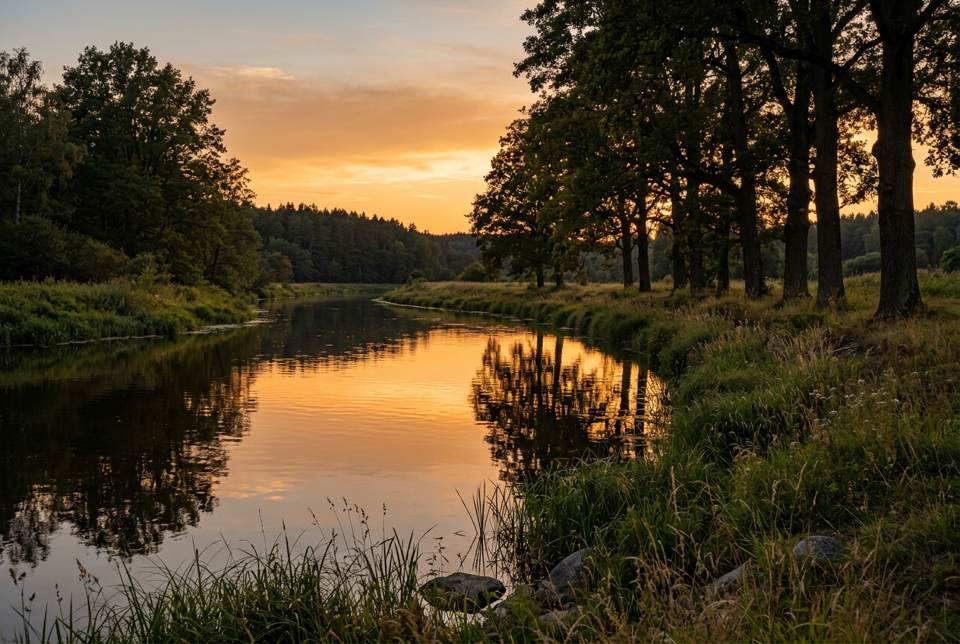
The Optics of Twilight along Rural Waterways
The interaction between low-angle sunlight and natural water bodies has long interested landscape artists, cartographers, and architects. When the sun approaches the horizon, sunlight travels through a thicker layer of the atmosphere, scattering shorter blue wavelengths and allowing longer red and amber hues to dominate the landscape. Along tranquil river courses and still lakes, this low illumination creates specular reflection, effectively transforming the water surface into a mirror that mirrors the visible sky.
During the late eighteenth and nineteenth centuries, topographers noted how evening light accentuates subtle variations in terrain. Low rays cast long shadows across gentle slopes, revealing forgotten earthworks, ridge-and-furrow field patterns, and historical boundary markers that remain invisible under vertical midday sun. Waterways act as natural amplifiers of this phenomenon, reflecting ambient skylight into shadowed riverbanks and under woodland canopies.
Architectural Orientation and Afternoon Shadows
Historic manor houses and country estates across western Europe were frequently built with precise solar alignment in mind. Architects considered not only thermal efficiency but also the visual effect of late afternoon light passing through principal reception rooms. High sash windows facing west capture the warm glow of dusk, casting elongated light rectangles across timber floors and plaster moldings.
Beyond interior spaces, landscape gardens were designed to harness evening shadows. Prominent avenues of lime or beech trees were aligned along east-west axes to create dramatic corridors of alternating light and shadow as the sun dipped toward the horizon. Ornamental ponds, cascades, and serpentine canals were situated specifically to catch the last rays of daylight, extending visual clarity across the grounds well past sunset.
Coastal and Estuarine Reflections in British Art
The study of light moving across broad stretches of water reached its peak in British landscape painting. Artists such as J.M.W. Turner and John Constable documented how water surface texture alters light diffusion. Smooth estuarine mudflats and calm bays reflect unbroken bands of color, whereas wind-ruffled waves fragment sunlight into thousands of shimmering points.
Estuaries present a unique visual environment where freshwater rivers meet tidal sea currents. As the tide shifts at dusk, the changing depth and salt concentration alter the refractive qualities of the water surface. Damp sand flats exposed at low tide retain a film of moisture that reflects the twilight sky as vividly as open water, creating seamless transitions between land, sea, and atmosphere.
Comparing Inland River Basins with Marine Horizons
While inland river valleys frame the evening sky between hillsides and foliage, open sea horizons afford an unobstructed panorama of the setting sun. The absence of terrain barriers allows light to stretch uniformly across the water, creating a prolonged gradient from deep indigo at the zenith to pale yellow along the horizon line. In modern coastal cities such as Dubai, viewing the setting sun against a prominent skyline from open water highlights the contrast between architectural steel and natural twilight tones. For observers examining vessel options for evening waterside excursions, current pricing and rental rates for Zubarah are available here, where reserving a catamaran or motor yacht provides an open view across the bay. Sitting near a quiet berth as dusk falls demonstrates how open marine settings transform the visual scale of both natural and constructed environments.
The Seasonal Shift in Evening Illumination
The angle and duration of dusk vary substantially throughout the calendar year due to solar declination. During midsummer, high-latitude regions experience extended periods of twilight, where the sun remains just below the horizon for hours, sustaining a soft glow across northern horizons. This prolonged illumination creates ideal conditions for observing subtle atmospheric changes and persistent cloud colors.
In contrast, winter twilight descends rapidly, bringing sharp color contrasts and crisp shadow edges. The lower moisture content in cold air often produces clear, intense hues of magenta and orange before fading into night. Understanding these seasonal variances allows land managers and visual historians to appreciate how historical properties and surrounding natural features were experienced by inhabitants throughout different times of the year.
The study of natural light across land and water remains a foundational aspect of landscape appreciation. Whether observed along a quiet riverbank or across an open bay, the fading rays of daylight continue to define how physical space, architecture, and geography are perceived.